20 July 2011: Can you imagine the excitement and elation I felt on discovering a mature Rhizophora x lamarckii in Pulau Ubin - a new mangrove record for Singapore? I was grinning with joy the whole day and went to bed so very happy that night. Sometimes, somehow, I cannot help but think I live a very charmed life indeed! [Haha] But profoundly though, I do feel quietly affirmed that my calling which I believe I have is real.
So as you can also imagine, my nature-loving friends were equally happy for me too. When I told them that R. x lamarckii is a natural hybrid of R. apiculata and R. stylosa, they were very intrigued and wanted to know more.
Here it is then, my friends - on your request - some simple diagnostic features of R. x lamarckii you can remember and use in the field. Happy exploring!!
 A closer look at Rhizophora x lamarckii: flowering specimen for the herbarium (below).
It was the stalk of the inflorescence (the peduncle) which blew me away the instant I laid eyes on the tree. The length of the stalk is so much shorter than R. stylosa and R. mucronata, but longer than R. apiculata! Fallen flowers at the base of the tree told me much more...
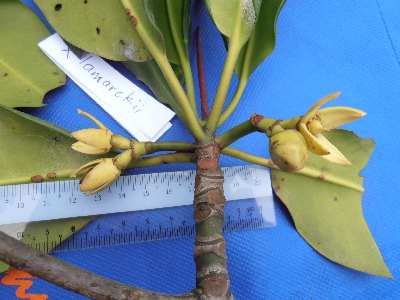 Compare the stalks of the inflorescences (peduncles) of R. apiculata, R. x lamarckii, R. stylosa and R. mucronata (from left to right).
 Compare the style and sepal width of the following 4 flowers: Differences and similarities described below.
Rhizophora apiculata (below): style very short - less than 1mm long.
 Rhizophora mucronata (below): style sharply pointed; appearing like a conical tunic with ovary.
 Rhizophora stylosa (below): style long; sepal width narrow to lanceolate like those of R. mucronata.
 Rhizophora x lamarckii (below): style long like R. stylosa; sepal width broad like R. apiculata.
 The density of the dots on the underside of mature leaves is markedly different for R. stylosa (left) and R. x lamarckii (centre) and R. apiculata (right); the last two being similarly and densely dotted though faint to see. R. stylosa, on the other hand, is similarly and spaciously dotted like R. mucronata (not shown here).
 The claw of R. x lamarckii (located at the distal end of the sepal) is prominently sharper to the touch than R. stylosa. The claws of R. apiculata and R. mucronata on the other hand are rounded instead.
 A dried petal of R. x lamarckii turns brown; margin white hairy.
 A good botanical drawing (shown in part below) of R. x lamarckii can be found in The Botany of Mangroves (by P.B. Tomlinson, The University of Cambridge,1986 ). Besides other features, the sharp claw of the sepal, hairy petals, bi-lobed stigma and long style are very well illustrated.
 R. x lamarckii is known to be vegetatively robust and vigorous. Our specimen is multi-stemmed and has prodigious flying buttresses and aerial roots bearing down in a messy tangle from up to 3m above.
 Bark rough and shallowly cracked. The biggest of the 5 major trunks measured 47cm girth.
 It lives in the soft substrate at the uppermost reach of a long snaking tidal creek.
 At about 12m tall, it is already towering a head above the surrounding trees.
 Detailed description and adequate photos of R. x lamarckii can be found in Australia's Mangroves by Norman C. Duke, University of Queensland, Brisbane, 2006. This hybrid can produce hypocotyl (seedlings) but fruit rarely develop beyond the immature fruit stage.