Wednesday, February 3, 2010

What is Explore?


What is Explore, or rather, explore.org? Thanks to Jon Kolker's introduction, I have found another new and exciting medium to learn and be inspired by the selfless act of people in the far flung corners of the world who have devoted their lives to extraordinary causes.

In the words of Explore, it 'is a brand new concept that combines philanthropy, travel, and learning. Led by Charles Annenberg Weingarten, and with support from the Annenberg Foundation, the explore team embarks on fact-finding missions to identify potential grant recipients and document the great works of nonprofit organizations through films and photography'.

I invite you to experience Explore, and add it to your list of portals to explore our beautiful world and feel the heartbeat and soul of humanity in all its challenges.

Cheers : )

Friday, January 8, 2010

Felled


If you can hear, my inner voice speaking behind these written words is soft to the point of void in a vacuum. I make the effort though. A giant Shorea ovalis (of about 250cm girth) has been felled by humans. I wished it not. A tree in the wild state of the Rain Forest in the Singapore Botanic Gardens; fruited July last year 2009; visited again recently and witnessed its full glorious crown... before it went down... and now an empty space of sky in the forest canopy.

8 Jan 2010: I saw the stump. It is healthy to the notch. Open flesh fresh a-lingering still. A few steps away lies two other stumps; trees of the same fate... silent... in the forest.

I make noise today though. A soft voice it is to speak the grievances the trees spoke to me that day. I want you to know how the wind came. Coming hardly the 10th minute of my wandering, it took post so strong and swept the sunlit floor into the gloom of angry clouds gathering above. Within the minute, wind and pelting rain released together. I hid and huddled below some trees with umbrella as I watched. And it rained and rained so forcefully; time standing still. The whole forest shook. How acutely I felt a great life force wrenching itself off the forest into the void above... so powerful and ominous a remonstration. Today this incomparable little voice tells you it happened. I cannot begin to ask why.

[Note: if you want to see the site of destruction, it is at the last bend along Liane Road, on the right as you approach the side-gate at Cluny Road.]

1) Fruits found July last year 2009.


2) Close-up of winged fruit.


3) Health stump of Shorea ovalis.


4) Galls on underside of leaves.


5) More galls of a different type. Amazingly I also found these same hairy type in an old herbarium voucher of the Gardens' Jungle Shorea ovalis collected by H.N. Ridley (no. 6393, dated 1894).


6) Looking for answers, a few days later, I went to ask the garden staff I found in the Potting Yard and to my horror saw the remains of the tree's trunk. [photos below by Angie Ng]

Sunday, December 20, 2009

Trees that touch and inspire

I planted the fig saplings more than a decade ago and she painted them years on as handsome trees that they have become. This is a sweet chapter of my life unfolded to me by chance a couple of weeks ago when I found the painting in a students' art exhibition at Lasalle, our famed school of the arts.

You can imagine the pure joy I felt then seeing my past effort rendered on canvas in beautiful colours. It felt like a fairy tale; sweet as memory-dews, coming full circle at a time for me to recall every step I took in the early life of these trees. I knew I had to share my experience with budding artist Ms Denise Jillian Tan (above). She should know, I thought; the story that enriches must be told and she is so much part of it now. I found her contact in due time and wrote her.

This is the story of the fig trees I shared with Denise:

"These fig trees were destined for the rubbish truck when I found them as forlorn-looking two-meter tall wiry saplings in torn-up bags at the waste-yard. They caught my heart and I salvaged them from sure destruction. I am happy for them now - so strong and spreading - providing figs for animals and shade for man, and not to mention, inspiration for Denise to paint them so beautifully."

[Photos above & below: Ficus benjamina var nuda (synonym: Ficus nuda)]

Subsequently I met up with Denise and her mum Catherine for a memorable lunch together. In her own words, she shared how the trees inspired her:

"I chose that tree [foreground] in particular because of its beauty. Its many branches stretching towards the sky, giving shade to the pathway, and its roots were most perculiar: emerging from the ground, almost like a reflection of the branches above - an assymetrical beauty of nature".

I must say I am extremely blessed with Denise's generosity of heart as she presented the gift of the painting to me. For this I remain forever thankful. I hope she will realize her dream of becoming a successful artist.

I also hope this charming story ends not here but continues as a first chapter to many many other stories of people drawn to the life of these trees. May they continue to grow, touch and inspire anyone who come under the spell of their generous loving embrace.

[Footnote: the 3 trees are figs: 2 nos. Ficus microcarpa and 1 no. Ficus benjamina var nuda (synonym Ficus nuda); located above slope overlooking Symphony Lake, Singapore Botanic Gardens]

Saturday, December 12, 2009

Two notable trees of MacRitchie Reservoir Park

Two notable trees worthy of special attention can be found in MacRitchie Reservoir Park today. Both are mature trees and both coincidentally exhibiting drooping branches of leaves. They are Anisophyllea griffithii, a tree of considerable rarity, and Shorea acuminata, a possible new record for Singapore.


Though I have known Anisophyllea griffithii or Griffith's Leechwood (photo above, centred) for many years, never have I the privilege of witnessing it in bloom. For this very reason the tree has become a necessary first-stop before starting my explores of the forest nearby. I must say I have grown very fond of this lovely tree over time. It is so graceful and elegant; so quietly enduring to the heart.

Shorea acuminata or Meranti Rambai Daun (photos below) on the other hand is conical in form, almost as if accentuating the lofty summit spot it hails - on the hillock above my lovely leechwood. Surprisingly, to say the least, I only discovered it recently in June this year 2009; this hillock being so small and I thought I knew all the trees there. I was proved wrong.

On that fateful late afternoon, the weather had taken a turn for the worse just as I was finishing surveying my lovely leechwood. Dark ominous clouds had gathered rapidly overhead. Not wanting to be caught in a storm within the forest, I decided to abandon my explore for the day. But not wanting to waste my long bus trip down from home, I thought I could make speed surveying the trees I know on the hillock before the rain hit the ground. So climbed I did, and ran straight into the tree - in quick time - serendipitously.

I realized pretty soon after why it had eluded me so far - the tree was completely entombed within an imposing fortress of tall hedging. If not for my habitual leechwood-stop... the weather a-fouling... the desperate quick-silver in trying to have some meaningful work done with precious little time on hand... and of course, a healthy dose of curiosity to investigate... it would have eluded me still.

To the non-discerning crowd, it may not come readily to think of the present immaculate MacRitchie Reservoir Park as a forested area decades ago. There are indeed a fair number of mature forest trees that had survived past development of the park. They remain as living signposts of the former forest there.

The need to know them presently comes at an urgent time when soon the summit will see the development of a new restaurant in place of the nice old canteen we are so familiar with. For this, I hope to document and map these trees soon with some civic-minded tree-lovers. Here again is another scope for what I call folk conservation.

Good friend Shawn in the foreground of Shorea acuminata atop hillock


Bole


Drooping branchlets

Earth-pointing leaves

Fallen leaves and stipules

Thursday, December 10, 2009

Aralidium pinnatifidum is NOT 'nationally extinct'

Aralidium pinnatifidum is NOT 'Nationally Extinct'. It should not be.

I am surprised the newly revised Red Data Book (2nd edition, 2008) still listing it as such.

Quite a few of these rare small trees are to be found barely inches away from the boardwalk at MacRitchie Nature Trail. Historically, they were only reported through collections from Bukit Timah and Jurong. Leaves are lobed as shown below but they can be entire too. The entire-leafed trees are also found at the boardwalk.

Saturday, December 5, 2009

A Family Gathering

I find myself in the field again today. Like so many times before it's like home. And it's the best home to be, this field of openness. The sky for the roof, the billowy clouds for my head and the breeze of familiar green giving thoughts quiet pools for reflections in the forest. And when it rains, you feel so alive.

Today I am with friends again, brothers and sisters that they be. A spider I bow to speak, a tree I raise my brow to in adoration... and then from on high descends a bird of rainbow light brightening a branch above. Funny how it seems that we are so complete: a spider, me, a tree and a bird. We are family; family in the depth of time and space; a moment in time as a family gathers around a spot of earth away from the artificial world.

A solitary ant-like spider the size of a 10c coin.

Ternstroemia penangiana flower.

Aborted female flower.

Chestnut-winged Cuckoo.

Tuesday, January 6, 2009

Rethinking Schools

If you think the future belongs to our children and that a good start to solving any of tomorrow's problems created today (example, the environment) is through education, you are right! Where should we start? Well, look no further than early childhood education!


I get goose pimples reading enlightened words from the Rethinking Schools. Check it out if you are passionate about education! Visit Rethinking Schools at:

http://www.rethinkingschools.org/

The following words should excite you like it did me. It's thoroughly breathtaking!

'Rethinking Early Childhood Education is alive with the conviction that teaching young children involves values and vision. This anthology collects inspiring stories about social justice teaching with young children. Included here is outstanding writing from childcare teachers, early-grade public school teachers, scholars, and parents.
Early childhood is when we develop our core dispositions — the habits of thinking that shape how we live. This book shows how educators can nurture empathy, an ecological consciousness, curiosity, collaboration, and activism in young children. It invites readers to rethink early childhood education, reminding them that it is inseparable from social justice and ecological education.
An outstanding resource for childcare providers, early-grade teachers, as well as teacher education and staff development programs.'


[Orignal excerpt can be read here.]

WOW! Take heart! Ecological Education!

Joe Lai : )

Monday, December 29, 2008

Wild Geese

In this beautiful poem I finally found a voice that so closely echoed all that was whispering in my heart one distilling dawn by the remote sea at Beting Bronok. There then I felt a gift had been given me - an epiphany of light and truth and the passion and joy of life screaming out to celebrate and to share. I felt so happy and I have learned so much. I am glad too the fleeting moment of my wondering at Beting Bronok I did capture. I called it Passion.

Mary Oliver's Wild Geese should move you out from wherever you may be into the light of living in the freedom of a priceless life, of discovering who you are and the world about you... i.e. if you chose to... fearlessly and lovingly... with acceptance and reckless abandonment. There is no time to lose.


Wild Geese

You do not have to be good.
You do not have to walk on your knees
for a hundred miles through the desert repenting.
You only have to let the soft animal in your body
love what it loves.
Tell me about despair, yours, and I will tell you mine.
Meanwhile the world goes on.
Meanwhile the sun and the clear pebbles of the rain
are moving across the landscapes,
over the prairies and the deep trees,
the mountains and the rivers.
Meanwhile the wild geese, high in the clean blue sky,
are heading home again.
Whoever you are, no matter how lonely,
the world offers itself to your imagination,
calls to you like the wild geese, harsh and exciting -
over and over announcing your place
in the family of things.

Source: Dream Work by Mary Oliver
published by Atlantic Monthly Press

Saturday, December 27, 2008

Dead Colugo found near Chestnut Drive

This is a belated sad news: a colugo had been found dead by the roadside near Chestnut Drive on Monday morning of 22nd December 2008.


Clarence Chua, who found it, commented:

"The specimen was laid out on the kerb. I think the driver put it there after hitting it. It was an adult I think. Hardly damaged, with only small drops of blood from mouth. Estimate that it died last night as the blood had dried. The spot was by a small sparsely wooded area in between Dairy Farm and Chestnut Drive Roads, about 1km off BTNR. I think it got hit by a car as it tried to glide from the wooded area to bukit gombak forest across the road.It's indeed saddening to see a relatively rare mammal die this way".


That morning, Clarence gave me an SOS call and started me off on a series of frantic phone calls to people who can help. Mr Leong Kwok Peng of nearby Diary Farm Adventure Centre responsed most expeditiously. He collected the specimen near Lamp post no. 142 within minutes of my call. He took photos and later called staff from Bukit Timah Nature Reserve to take it off his hands.


Thanks Clarence, thanks Kwok Peng, for your concern and speedy action. The colugo may have died, but because of you, some invaluable data (which could well be revealed by expert studies of a rare fresh carcass) did not die along with it. Interestingly, the first people I called - RMBR (Raffles Museum) - turned down my offer of a fresh specimen.

[Photo credit: Leong Kwok Peng]

Monday, December 15, 2008

Trilobite Larvae: The Peter Pan of the Insect World

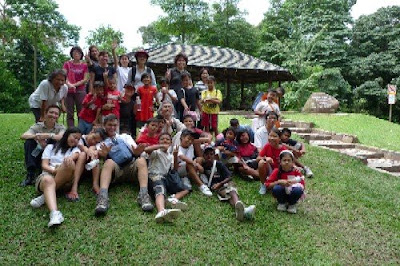
On a recent outing up Buikit Timah Hill with some wonderfully-kind folks from sponsor SPRING SINGAPORE and beautiful kids from BEYOND, I had the rare opportunity to explain the natural history of the Trilobite Larvae and how special it is. We found one (about 8cm long) crawling on a rotting log. Interestingly, this one remained completely still (as if pretending to be dead or lifeless) when we moved closer to look.


A fascinating account of the Trilobite Larvae can be found in the blog Bianca Sunshine.


Along the way, the Creepy Crawlies - a centipede, a millipede, a leafhopper, stingless bees, giant forest ants, a palm nettle caterpillar, a longhorn beetle, butterflies, a bush cricket, plenty of pond-skaters, a jumping spider, a super long-legged cranefly and a forest cockcroach - came out in force to entertain the kids and opened up for them a little window into the incredible world of the Rainforest! : )

Saturday, October 25, 2008

New Book: The Bridge at the Edge of the World

New Book Recommendation:
The Bridge at the Edge of the World: Capitalism, the Environment, and Crossing from Crisis to Sustainability - by James Gustave Speth, Dean of the Yale School of Forestry & Environmental Studies

Excerpts: Seeing an “emerging environmental tragedy of unprecedented proportions,” Speth says the book’s aim is to describe a non-socialist alternative to capitalism. That alternative includes moving to a post-growth society and environmentally honest prices, curbing consumerism with a new ethic of sufficiency, rolling back growing corporate control of American political life, and addressing the enormous economic insecurity of the average person.
“My point of departure is the momentous environmental challenge we face,” Speth says. “But today’s environmental reality is linked powerfully with other realities, including growing social inequality and neglect and the erosion of democratic governance and popular control.” Speth examines how these seemingly separate areas of public concern are intertwined and calls upon citizens to mobilize spiritual and political resources for transformative change on all three fronts.


Enter here to listen to the author as he speaks about the challenges we face today and how real transformative change can come about.

More about the book at: http://www.thebridgeattheendoftheworld.com/

Friday, October 24, 2008

Consume Less!

I was wondering what photo to use in this post of mine when I chanced upon the photo below: an outdoor toilet or 'jamban' in Pulau Ubin.

'How appropriate!' - I thought - abstract but absolutely dramatic! It brings to bear the 'shit-house' of a dwelling place we have built for ourselves through consumeristic wanton-ness and consequential waste in an otherwise sustainable earth.

To be true, our 'jamban' may be small (considering how insignificant the human species is in the scheme of earthly life), but our self-destructive hunger for more leaves no corner of the earth unfouled. And this is exactly what modern society tells us to do day-in-day-out: it tells us to CONSUME more and more, BUY more and more!

The following short film by Leo Murray and an essay by James Gustave Speth - 'Environmental Failure: A Case for a new Green Politics' - tell us what we CAN and MUST do. Simply put, we are being called to revolutionary actions beyond our personal footprint-watch.

Short Film: Wake Up, Freak Out - then Get a Grip

James Gustave Speth: 'Environmental Failure: A Case for a new Green Politics'

Here's an excerpt from the short film (written by Leo Murray):

"There is no great mystery about what we need to do to reduce emissions in line with the science; we simply need to consume less.
But that is out of the question in a society which is founded on the ever-increasing consumption of materials and energy.
Nobody has all of the answers; but we do know that this is not the only way to live, and given that it is almost certainly going to kill us all, we had better start looking urgently at some of the alternatives. It is now very clear that in order to actually win the fight against climate change, making big changes to the way we each live our own lives is not going to be enough; we’re also going to have to actively confront powerful vested interests who will stop at nothing to prevent the changes we need from taking place. We have to be more than just consumers.
These are extraordinary times. Preventing runaway global warming is the single most important task in all of human history – and it has fallen to us to do it. If we don’t, then everything else we work to achieve in our lives will be destroyed, or become meaningless. Those who came before us didn't know about this problem, and those who come after will be powerless to do anything about it. But for us, there's still time! We'd better get a move on though."


CONSUMING LESS - it is the only way to go.

Read also New Scientist: Endless Growth is Folly

cheers,

Joe Lai

Sunday, October 12, 2008

My Sundew Has Grown!

My sundew has grown! It has caught its first insect! I am so proud : )

Take a close look. See how the red stalks rising from the leaf surface bear droplets of mucilage that hold the insect. The photo below shows how the stimulus of the contact makes adjacent stalks bend toward the insect, tying it down more securely. These same glands that secrete mucilage then exude digestive enzymes and later resorb the digested products as nutrition for the sundew.

Recently, I conducted a special leaf workshop called 'Leaves You Captive' for 25 homeschool kids. We learned what is a leaf and why a leaf is so important to the plant. We learned through many examples the great diversity of leaf forms and functions. A leaf can be very special - like the sundew, for example. In the wild, the leaf can make a difference to the survival of the plant. Besides helping to receive sunlight and produce sugar-food for the plant through photosynthesis, a leaf can help a plant to do all sort of marvellous things - to climb, to hold water, to provide food and home to symbiotic animal-friends, to attract pollinators to the flowers, to float, to protect the plant from predators, to trap insects, and yes, to help the plant reproduce vegetatively too!

John (above) is one of the homeschool kids who attended my workshop. He likes to share his learning experience with all his friends. [Thanks John! I am glad you enjoyed the workshop.] This is what he wrote:

What Uncle Joe showed us:
Uncle Joe showed us a plant called “Doodle”(Sounds like noodle; and looks like yellow noodles).He also showed us a type of fern that can make a silvery white mark on things. It is called Silver Fern.


What we did:
We went for a treasure hunt and I found the following plants: Sea Hibiscus, Bougainvillea, Barrel Cactus, Bromelid, Kalanchoe, Sundew, Dischidia and Pitcher Plant.

Facts:
Leaves can be oval shape, heart shape, round shape, sword shape, fan shape, oblong shape, spoon shape, toothed, feathery and lobed. The Pitcher Plant (also called monkey cup) and the Sundew are CARNIVOROUS!! Under the dead leaves of the Bird’s Nest Fern, there may be BATS.

What I saw and how I feel:
I saw a water skater, a LARGE SPIDER and a strange insect. I feel very happy because I learned a lot of things and I saw lots of INSECTS.

Other Information: 1) Leaf Workshop 'Leaves You Captive' 2) How to pot sundew and venus fly-trap from culture.

Tuesday, September 23, 2008

New Young Writers Inspired by Pulau Ubin and Chek Jawa

Hurray! Three bright young ladies have joined Flying Fish Friends as Young Writers!

Meet Koo Ning, Samantha and Phoebe! They are all cheerful homeschoolers and happy learners.

Koo Ning has many friends who are already Young Writers. Beside taking part in dance performances, she wants to be a writer too.

Samantha and Phoebe are sisters. They have a natural flair for writing. I am particularly pleased by the fact that they were inspired by Pulau Ubin and Chek Jawa to start blogging.

[Photo above: Samantha (in pink) and Phoebe (green-striped shirt) at Pulau Ubin]

Here are their new blogs:

Koo Ning's Swimming Bird

Samantha's Shimagoma

Phoebe's Pandagoma

May I invite you into the wonderful world of Koo Ning, Samantha and Phoebe!

CHEERS!

Uncle Joe : )

Friday, September 12, 2008

How to pot Sundew and Venus Fly-Trap from culture


(1) Open bottle only when ready to pot plant. (Potting mixture should be peat mixed with perlite)

(2) Wet potting mixture thoroughly with overnight boiled water or preferably rain water.

(3) Lift plant gently out with tweezer and wash off agar by swishing it gently in a small tub of water.

(4) Plant it in the potting mixture and put under indirect sunlight. Do not water plant directly. Instead, put plant pot in shallow tray and ensure tray has sufficient water at all times.

(5) It will take a week or two for plant to slowly acclimatize to external environment. This process can be done using a clear plastic bag and rubber band to cover the top of the pot or seal the top with an airtight cover. Over a period of two weeks, make small holes on plastic cover, increasing the number of holes everyday, or sliding off the cover for 5 minutes on the first day and extending 10 minutes, 15 minutes, half an hour and beyond every subsequent day. After two weeks the plant should be fully acclimatized to the external environment, after which you can expose it to direct sunlight but not for the first month at least.


Saturday, August 30, 2008

Botanical Workshop: Leaves You Captive

Leaves You Captive is a captivating hands-on learning journey for children to explore the fascinating world of leaves. [Photo below (by Alex Teoh): Drosera burmannii, native sundew of Malaysia]

With the aid of as many as twenty plants, the workshop showcases leaves of various shapes and sizes, colours and textures. Specimens include the leafless Dodder Plant and plants with leaves that float, climb, help pollination, produce nectar, provide homes for insects, etc.

The carnivorous Sundew and Venus Fly-trap - whose leaves lure and trap insects - are the highlights of the workshop. These are used effectively to tell the story of how plants adapt and survive in their own unique environment. Each child will be presented with a sundew for growing and study at home.

Leaves You Captive serves to capture the imagination of the child to the wonderous diversity of leaf forms and functions and understand profoundly how the basic building blocks of life on earth start with the LEAF in its ability to capture energy from the sun and render plants as primary producers - direct or indirect food - for almost all living creatures. Little wonder the Chinese saying of old: See the World in a Leaf.

[Photo above: Drosera nidiformis]

[Photo above: Drosera spathulata, a native sundew of Malaysia]

[Photo above (by Richmond): Dionaea muscipala, Venus Fly-trap caught a fly]

Sunday, August 24, 2008

A Rare Native Tree 'Uncovered' in Serangoon

It is a native tree, Cordia dichotoma - one very rare living specimen in today's Singapore - finally 'uncovered'!

Why 'uncovered' and not 'discovered'? Well, it's because I have long known the tree in Serangoon (Rosyth Road) but its identity has eluded me till now; it's fruiting! I don't usually come this way, so I might have missed some previous fruiting spells if any. But yesterday's encounter was simply MAGIC... 'uncovered'! : )

It's a tree of back mangrove and coastal hills. In former days, it must have been found everywhere in Singapore, not just primary rainforest. I bet, if we look hard enough, there is a high chance some can be found in the relatively undisturbed southern islands of Singapore today, e.g. Pulau Senang or Pawai, and not discounting outbacks like the Western Catchment (which is off-limit to the public) and Pulau Ubin.

The fruit contains a sticky pulp and favoured as gum to the extend of being introduced into the villages of old in Ponggol, Changi and Chua Chu Kang. One name given to it attests to its gummy property - Birdlime Tree. The other common English name is Fragrant Manjack. A quick chat with the taoist nun living in the adjacent temple revealed it was planted by the temple's keeper more than 30 years ago.

Literature also tells of a tree which is highly diverse in its leaf shape and colour of its fruit. In exceptional circumstances it has also been found to thrive as a woody climber in Malaysia. Not surprisingly, three 'species' were previously recognised instead of one - all due to taxonomic confusion arising from wrong identification. It does make my present 'un-covery' all the more satisfying, doesn't it? : )

For those tree-lovers out there, don't wait too long to pay homage to this tree. More photos are found here in my Companion Guide to Wayside Trees of Malaya.

In the meantime, I have collected seeds which I will donate to the Singapore Botanic Garden and yes... Sungei Buloh Wetland Reserve! Yeh!! This is definitely a native tree of cultural significance to be preserved.

The other two Cordia species in Singapore are Cordia cylindristachya and Cordia subcordata.

Joe Lai : )

Wednesday, July 30, 2008

Salads: Love Food by Busy Dads

Dear friends,

lately I have been concocting salads for myself. Firstly, it is a health choice for me. Now that I am reaching fifty in two years, I thought I had better have a good early start now than later down the road to a golden robust age. My second reason for going the way of the vegetables concerns animals. Recent news reporting sadistic physical abuse on cattles by ranchers in USA turn me round finally from eating meat today. Call me silly, but I felt better each day not eating meat in solidarity with the animals. However, I have decided to adopt a slow approach to my diet change, i.e. eating seafood still but not big animals - poultry, pork, beef and mutton. So far, I am glad to say I have not suffered any withdrawal. Actually, it has been a breeze. Who knows, one day, a vegant I be.

But my unashamed profession here is not the reason why I am writing to you now. It is the busy dads of homeschool kids I like to reach out to here. Why? Read on...


You see, I have also begun introducing salads to my son Min. I remember the pleasant smile beaming from his face when I presented it to him the first time [see photo above]. I caught him by surprise with a dish decorated evidently with lots of love. The wonderful thing is: I was taken by surprise too - stumbling as I did into a simple but profound way to shower him with love!

Since that wonderful day, I have been inventing new salad combination for Min. It is not a daily routine but at least twice a week I feed him with my 'love food'. : )

So, this is what I like to share with busy dads of homeschool kids: You Can Make a Beautiful Salad once in a while to show your love for your child. It is as easy as ABC!

Hope this will help dads with teens who are growing out of the 'hugs and kisses' phase and looking for ways to capture their hearts still... : ) Here's a few other photos of my love food.

Photo above: Experimenting with fennel that I have never eaten before. Delicious!

Photo above: Baby cucumbers really easy and refreshingly quenching.

Photo above: Mixing fruits with vegetable adds colours and vitamins.

Photo above: Miso soup with Mushroom-noodles and Scallop-mushrooms.

Photo above: You can mash up broccoli and chinese-cabbage after steaming. Very interesting texture. I experiment with dried papaya strips (red in colour).

Photo bove: Yummy! Cute cubes of tea-tofu with Miso!

Hey! Maybe we dads should organise a gathering of sort to start tasting vegetable and stuff, eh? I don't mind sharing my little discoveries! hee hee!
Joe Lai : )