Wednesday, February 8, 2012

Tulostoma: Rare Fungus in Chek Jawa Coastal Forest

Never a day in Chek Jawa and not learning something new. Here on her coastal hill is found a rarely seen fungus called Tulostoma.

Its leathery basidiocarp is shaped like a miniature durian a centimeter in diameter and borne on a stalk. Because of this unique feature, it is commonly called a Stalked Puffball.

The immature basidiocarps are brown, woody and inconspicuous.

It makes me wonder if Tulostoma (as rigid as it appears) disperses its spores in the same explosive way as other puffballs do, and whether the wild boars whose presence on the coastal hill is so evident smell them out and snack on them.

There is truly no end to wonderment in Chek Jawa, I must say. You are ten thousandfold more likely to drown in wonderment than from any mishap in the seas here. [ha ha]

And if I may invite you to pause a moment to imagine Tulostoma's mycelia - those invisible masses of fungal threads that bind and effect life in the good earth - maybe we might just allow Chek Jawa to expand our thoughts into her invisible and infinite embodiment of cells - of all her plants, animals, protists, bacteria as well as fungi - and imagine relationships upon relationships beyond the phenotype to the molecular, the genes and the proteins... we might just see the common Thread of Life we share so intrinsically and how inseparable we humans are even to the inorganic minerals found in the rocks of Chek Jawa, dissolved in the seas and falling from the sky.


Saturday, February 4, 2012

Calophyllum pulcherrimum: Additions to the Flora of Keppel Island

She is indeed a double beauty - beautiful, most beautiful. Calophyllum pulcherrimum derives her name from Greek Kalos - beautiful, and Latin pulcherrimum - most beautiful.

Last week, she set off a most spectacular firework of creamy white flowers shooting in all directions from her lofty perch atop the small hillock at Keppel Island. I could not have asked for a better start to my second flora survey of the island.

There was only one leaf at the foothill but I found it. A fine-veined somewhat glossy leaf a-glimmering in the light. It was as if cast down like a delicate silk handkerchief to snare my attention and say, "Hey Joe, I am here above. Look. Don't miss me out in your census ok".

I present you thus a list of additions (including Miss Beautiful-Most Beautiful) to the Flora of Keppel Island below.

Additions to the Flora of Keppel Island
Arthrophyllum diversifolium
Asystasia nemorum
Calophyllum pulcherrimum
Caryota mitis
Cissus hastata
Clidemia hirta
Cocos nucifera
Crinum asiatica
Dendrophthoe pentandra
Dicranopteris linearis
Dillenia suffructicosa
Elaeis guineensis
Fibraurea tinctoria
Ficus microcarpa
Lygodium circinnatum
Lygodium microphyllum
Mikania micrantha
Nephrolepis biserrata
Pandanus odoratissimus
Passiflora laurifolia
Ptychosperma macarthurii
Spathodea campanulata
Syzygium campanulatum
Taenitis blechnoides
Triphasia trifolia
Vitex pinnata

Wednesday, January 18, 2012

Gordonia penangensis: A Treasure on Keppel Island


Standing wild and free on the northern face of Keppel Island is a veritable grove of native trees of undisputed rarity and antiquity. It is really a miracle how they could have survived against the relentless pace of urban and economic development engulfing them from all sides. Yet they did.


Tall and brave I see them now as soldiers defending their fort on a knoll facing ultra-modern Reflections by the Bay in defiance. True courage, like flowering, comes spontaneous and pure and lives forever. It may wilt but never die. The spirit lives and re-appears again and again.


Finding Gordonia penangensis and finding it flowering thus is metaphorically so profound. It is as rare as courage standing up to the threat of extinction from its native soil. We must stand on their side and fight the good fight.


I am glad I came on Sunday (15 Jan 2012) to explore. It is my first visit to the island though I knew it since 1981 as a young navy man called to the Fleet at Pulau Brani. Back then, Keppel Island was known as Pulau Hantu. Few would have known there were actually 2 Pulau Hantu's in Singapore. But we did.


It was just a tiny island with a shack or two and a small untidy wharf on its southern shore. Over time it grew a little bigger and now completely transformed into a playground for both the rich and poor, young and old. I am glad its forest persisted. We ought to treasure it and keep for good.


To those interested in history, geography and botany of Singapore, I present you some old maps (below) which bear the old name, and also a hearty roll call of plant names proudly served to you as a first flora of Keppel Island. May these soldiers live forever in our heart and mind.


First Flora of Keppel Island listed right below of this blogpost. Notable find in bold and exceptionally significant in red.


Northern shore of Keppel Island (indicated by black arrows) where the grove of trees are located. The new coastal walkway runs along the yellow line.


The pre-transformation look of Keppel Island.

Old map no.1

Old map no. 2


Old map no.3

First Flora of Keppel Island
Acacia auriculiformis
Acacia mangium
Adenanthera bicolor
Adenanthera pavonina
Alstonia angustifolia
Bhesa robusta
Buchanania arborescens
Calophyllum inophyllum
Canthium confertum
Carallia brachiata
Casuarina equisetifolia
Cerbera sp.
Champereia manillana
Cinnamomum iners
Clerodendrum laevifolium
Commersonia bartramia
Diospyros lanceifolia
Dracaena maingayi
Fagraea fragrans
Ficus grossularioides
Garcinia nigrolineata
Gordonia penangensis
Guioa pubescens
Gynochthodes sublanceolata
Indorouchera griffithiana
Ipomoea pes-tigridis
Lasianthus cyanocarpus
Litsea elliptica
Macaranga heynei
Melastoma malabathricum
Memecylon edule var ovatum
Morinda umbellata
Oncospermum tigilarium
Palaquium obovata
Pouteria obovata
Pteris vittata
Rapanea porteriana
Rhodomyrtus tomentosa
Rodamnia cinearia
Sapium discolor
Scaevola sericea
Streblus elongatus
Symplocos adenophylla
Syzygium glaucum
Syzygium grande
Syzygium palembanicum
Syzygium zeylanicum
Tetracera indica

Tuesday, October 18, 2011

A Light Above Pedra Branca


There is a Light
above a Rock
called Pedra Branca
and I hope it will burn forever bright.

Burning, I hope, not so much a guiding star for sailors, but for the people I belong to: Singaporeans.

Indeed, for me, Horsburgh Lighthouse, stands out not so much as an engineering feat than as a monument; a monument to the people who built it. They were our first dream team ever - a team comprising none other than the Malays, Indians, Chinese and Caucasians. And you know, wrought they did their finest mettle against the 'first test' to build a common light together. It was, as I found out, a task exceedingly difficult and seemingly impossible in so many ways.


With only sail-driven ships, raw human muscles and simplest of wooden rigs, planks and lashings, they transferred and hoisted huge pre-hewn granite blocks (doughnut-shaped sections originating from Pulau Ubin) onto steep treacherous rocks against the rough open seas and getting caught out often in the middle of tempestuous storms tossed by wind and waves, or tormented by the blistering sun otherwise.


However, the most difficult of all is the barrier of mistrust and misunderstanding confronted by the different ethnic groups working together in tight confines for the very first time. Fortunately, the situation managed to resolved unto itself (after some very bitter start); a job had to be done, and it finally got done. The final capping of the finished product must have been a very sweet moment for every hand on deck and rock, I can imagine.


In year 2002, I first learned in detail of the struggle of this first dream team in a neat little booklet entitled "The Horsburgh Lighthouse" by John Hall-Jones. My heart naturally went out to the workers, many of whom did not even know what they were in for and left with no choice marooned on a rock.

John's writing, in particular, left a big gaping void that could otherwise have contributed to our understanding of the workers' predicament and their psychology as a migrant worker looking for a better life or that of a convict worker hoping for a much cherished pardon. It was obviously a book much-ado with Thomson the man and the lighthouse he designed and built. John's characterization of the workers could have been less harsh at times, I felt, had he understood how no one (given a choice) would want to put one's life at risk for a job.


So it was with great personal satisfaction that I finally found (in the Epilogue) the photo and description of a silver farewell testimonial presented to Thomson 'by a group of leading citizens of Singapore' that I felt honoured the sweat and blood of these humble workers themselves, albeit in a very subtle yet respectable manner. We will never know who designed this beautifully intricate epergne, but I bet he certainly felt in his heart (like I did) the injustice of the underdogs and gave them back the credit they deserved.

My Own Epilogue


All this searching came about in 2002 because having been told of stories of indentured workers working the quarries at Pulau Ubin, I visited some of their unmarked graves. I remembered feeling very sad seeing them for the first time. They were graves with no names; unmarked gravestones of poor souls who died alone and whose last thought must have been the home across the seven seas they never got back to. I had made a promise then to write something in their remembrance. This I do here. To the indentured workers and convict labourers, we owe you lots.


In conclusion, whatever false start the first dream team have had, they certainly pulled themselves together quickly to weather the storm and conquered positively with resolution and endurance. They must have learned a lot working together and I believe we can learn a lot from them too. It is more than a lighthouse we inherited; it is a light that will burn forever bright to guide us in our multiracial society today.

Footnote: If we can spend tens of millions obtaining sunken Tang Dynasty Treasures to depict the history of our maritime trade, why not seriously consider repossessing this little silver of burning light for our future generations. I believe, it is presently with the descendants of John Turnbull Thomson in New Zealand.

Other information: Mok Ly Yng on "Horsburgh Lighthouse: 160th Anniversary" (Sat 15 Oct 2011)

Description of the Silver Epergne in the booklet: Before he departed a group of leading citizens of Singapore banded together to present him with a silver testimonial in appreciation of his service to the Settlement. A unique and intricate silver epergne was fashioned by a master of the craft and presented to Thomson on the eve of his departure in August 1853. Significantly it was engraved with etchings of the Pedra Branca rock and the Horsburgh Lighthouse and surrounded with figures to represent the Chinese, Indians and Malays who had worked under him.

Friday, August 26, 2011

Tree Felling: The Saddest Sight in CIAG (City In A Garden)

This is one of the most vibrant part of Singapore City - the lively busy junction at Singapore Management University (SMU) where trees gracefully line both Bencoolen Street and Bras Basah Road. This is the 'happening' place - a happy place, I must add - where students, young people and tourists mingle, have a great time with food, museum visits, attend school and churches and going to cinema and open-air concerts with family and friends.

But what do we find here today - 26 August 2011 - eve of our Presidential Election 2011?

SHOCKING - 7 large tree stumps of felled Yellow Flame Trees lined in a death row along Bencoolen Street for the whole world to see!

That's not all. If you are as familiar as I am with trees in Singapore, you will know that 3 more big trees fringing Hotel Rendevous (white building; below photo) have also been cut and cleared of almost all evidence on the opposite side of the street.

It is simply the saddest sight in CIAG (City In A Garden) and it hurts.

Each stump a face of destruction, a real bad education, that immediately bring up images of deforestation, climate change, and - not by a long stretch - a worse possible counter- advertisement for CIAG's promotion of urban greenery and ecology. Bencoolen Street is so treeless, ugly and hot now.

But what awaits the fate of the remaining trees fringing Plaza By The Park along Bras Basah Road?

Will they be felled too?

The common man in the street needs some answers. It hurts, really hurt to the core! Why, o why did we cut these lovely benign trees that is so much a part of everything beautiful here? WHY? : (


Tuesday, July 26, 2011

New Mangrove Record: Rhizophora x lamarckii

20 July 2011: Can you imagine the excitement and elation I felt on discovering a mature Rhizophora x lamarckii in Pulau Ubin - a new mangrove record for Singapore? I was grinning with joy the whole day and went to bed so very happy that night. Sometimes, somehow, I cannot help but think I live a very charmed life indeed! [Haha] But profoundly though, I do feel quietly affirmed that my calling which I believe I have is real.

So as you can also imagine, my nature-loving friends were equally happy for me too. When I told them that R. x lamarckii is a natural hybrid of R. apiculata and R. stylosa, they were very intrigued and wanted to know more.

Here it is then, my friends - on your request - some simple diagnostic features of R. x lamarckii you can remember and use in the field. Happy exploring!!

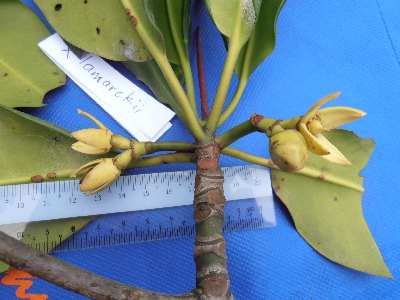
A closer look at Rhizophora x lamarckii: flowering specimen for the herbarium (below).

It was the stalk of the inflorescence (the peduncle) which blew me away the instant I laid eyes on the tree. The length of the stalk is so much shorter than R. stylosa and R. mucronata, but longer than R. apiculata! Fallen flowers at the base of the tree told me much more...

Compare the stalks of the inflorescences (peduncles) of R. apiculata, R. x lamarckii, R. stylosa and R. mucronata (from left to right).

Compare the style and sepal width of the following 4 flowers: Differences and similarities described below.

Rhizophora apiculata
(below): style very short - less than 1mm long.

Rhizophora mucronata (below): style sharply pointed; appearing like a conical tunic with ovary.

Rhizophora stylosa (below): style long; sepal width narrow to lanceolate like those of R. mucronata.

Rhizophora x lamarckii (below): style long like R. stylosa; sepal width broad like R. apiculata.

The density of the dots on the underside of mature leaves is markedly different for R. stylosa (left) and R. x lamarckii (centre) and R. apiculata (right); the last two being similarly and densely dotted though faint to see. R. stylosa, on the other hand, is similarly and spaciously dotted like R. mucronata (not shown here).

The claw of R. x lamarckii (located at the distal end of the sepal) is prominently sharper to the touch than R. stylosa. The claws of R. apiculata and R. mucronata on the other hand are rounded instead.

A dried petal of R. x lamarckii turns brown; margin white hairy.

A good botanical drawing (shown in part below) of R. x lamarckii can be found in The Botany of Mangroves (by P.B. Tomlinson, The University of Cambridge,1986 ). Besides other features, the sharp claw of the sepal, hairy petals, bi-lobed stigma and long style are very well illustrated.

R. x lamarckii is known to be vegetatively robust and vigorous. Our specimen is multi-stemmed and has prodigious flying buttresses and aerial roots bearing down in a messy tangle from up to 3m above.

Bark rough and shallowly cracked. The biggest of the 5 major trunks measured 47cm girth.

It lives in the soft substrate at the uppermost reach of a long snaking tidal creek.

At about 12m tall, it is already towering a head above the surrounding trees.

Detailed description and adequate photos of R. x lamarckii can be found in Australia's Mangroves by Norman C. Duke, University of Queensland, Brisbane, 2006. This hybrid can produce hypocotyl (seedlings) but fruit rarely develop beyond the immature fruit stage.