Monday, November 11, 2013

Postcards to Our Dear Prime Minister

It has been 20 years of field experience in our forest and many a moment I have been spellbound and moved beyond words to express my love and joy in paintings. But words are beautiful too. Why not combine both? The idea of transforming my paintings into postcards was borne. This is surely a novel way to reach out to fellow Singaporeans and provide them a simple platform to enter into a meaningful dialogue on an important issue close to home - our rain forest.

As you already know, Cross Island (MRT) Line has been proposed and according to the initial pronouncement, the track will cut straight through our rain forest belt north of MacRitchie Reservoir - in a part of Central Catchment Nature Reserve that has been rigorously studied and reported to be significantly rich in biodiversity. Fondly known as MacRitchie North, this lowland Dipterocarp forest which comprises a unique freshwater wetland, is immediately east of Bukit Timah Nature Reserve; the two only recently joined by a $17 million dollar bridge designed specifically to facilitate animal movement across BKE expressway which for 20 years have seperated the two reserves.

Since the launch of my humble postcard project, I have entered into numerous conversations with people. Many like to write but asked how. My short and spontaneous answer has always been to write from your heart. Thinking back, I can't help smiling. That's how I write. I think I do owe people the long answer.

Writing should never be a chore. It must spring from purpose and conviction which must in turn spring from personal experience. Remember the happiness and that deep sense of being you found in Nature? When you write, Happiness will bring with her two great friends - Hope and Dream - of a better world. When you write genuinely from your heart, your words will flow with the under- current of these three. So, to start with, reflect on these and believe why you want to write.

Now that you have set the foundation rock solid, you are ready for the practical. Take out a piece of paper and scribble all the thoughts you have on the issue for a week. By then, you would have spun a spider web, and you would have found your inner voice chord. You will be pleasantly surprised to find how well note-taking helps in conceptualising thoughts.

Now that you have found your voice - those key ideas and words - put that piece of paper far away. Have faith and write straight away. Start with the first word, a first simple sentence, that comes to mind. The rest will follow for sure.

When you write, keep it simple. Be polite and respectful. Begin with appropriate salutation and end with a thank you and legitimise your voice with proper identification. A name just won't do. Put in your NRIC number or contact, and don't forget the date. The small space of a postcard is sweet and short and you will find it a great start to writing precisely.

Lastly, what is all this instruction (above) without leading by example? So, let me share with you some that I have written (below). My most profound wish is for people to participate in dialogue and speak for Nature before it is too late to do so. Wait no more. Write now!

If you like to acquire my postcards, please write to me at joelai1959@gmail.com.

Dear Prime Minister, Sir,
I feel humbled yet delighted in writing to you. I write from my heart with love for my homeland and my beloved community Singapore. I truly believe your job is not an easy one, and more so if citizen such as I do not speak up and participate in dialogue on important issues concerning our home. I care. Can MRT cut into the forest with absolute zero impact? Our forest is a living system sensitive to degradation and irretrievable lost to its complexity. I beseech you – humbly – keep our forest safe from any conceivable harm. Thank you. Yours Truly, Joseph Lai (NRIC no.) 4/11/13

Dear Prime Minister, Sir,
Water is gold. Our rain forest is our golden goose. It regulates the rain cycle and makes rain for us for free. Our forest streams sparkle with life – our life. The MRT line cutting into our precious forest will kill our golden goose. Surely, we must never forget our primary source. 饮水思源 No expensive and ever-costly ultra-filtration or desalination processes can ever replace this resource. Our forest gives us water... and much much more. Thank you. Yours Truly, Joseph Lai (NRIC no.) 4/11/13

Dear Prime Minister, Sir,
I have a 20-year love story with the rain forest and still walking with it today. It has also been 20 years of educating the young. What I have learned from Nature is beyond what I can see or think about, but what I can feel with my heart. The wind, the clouds, the sunrise, and sunset – all and more have given me a beautiful poetry to my heart and a song to my steps. I believe I must have rubbed off this spirit and lightness of mine onto all who walked with me. Trust Nature – the best classroom to nurture children with compassion, passion and dreams of a better world. Thank you. Yours Truly, Joseph Lai (NRIC no.) 4/11/13

Dear Prime Minister, Sir,
The best health insurance we can give to our future generations is an intact and healthy rain forest of unparallel genetic diversity. The frontier of bio-medical sciences lies in this genetic diversity. Surely, the road to a bright future is not by cutting an MRT line across our precious forest. It calls for sacrifice: preserving our fragile forest today. A little inconvenience in transportation is O.K. I humbly beseech you. Thank you. Yours Truly, Joseph Lai (NRIC no.) 4/11/13


Monday, January 14, 2013

Stephanotis maingayi rediscovered


No two field trips share the same complexion except in being extraordinary and special; where new things are learned and new insights gained. 

Last Sunday's unhurried exploration in MacRitchie forest is no exception. It is as extraordinary as I would like it to be. I need only to surrender to serendipity and have eyes as fresh as newly opened flowers. My heart feels light, my mind illuminates and I walk as tall as the trees. My forest, my home - my home sweet home. I love it with all my heart and might.

The first and only known local collection of Stephanotis maingayi was Hullett 147 at Changi (undated). A good sense of time, however, can be cultivated in knowing who Hullett was. 

Richmond William Hullett (his full name) was a most respected scholar and the longest serving headmaster of Raffles Institution in Singapore (1871-1906). Through 1880s and 1890s, Hullett was a prolific plant collector. He took every opportunity to collect and record exotic plants during breaks in the academic calendar for school holidays. His collecting work on Mount Ophir (Malaysia) is especially noteworthy. 

In sharing with you Stephanotis maingayi, I would like to draw you to Hullett's biography (found here) which speaks volumes of his great intellect and inspired presence which touched so many a student under his care. Among them were our respected forebears Tan Teck Soon and Lim Boon Keng. 

I leave with you here the nice warm feeling of rediscovering a long lost climber once recorded in Changi, now in MacRitchie. 

Fallen corolla, creamy white, withering yellow.
Green calyx on long stalk. Hullett's description: "Between
Changi Bangalow and Sungei Salarang covering the
whole jungle side. Flowers white as large as wine glass."
Coiling stem, slender and fine-hairy.
Clear sap
Leathery leaves, ovate to oblong.
Leaf base heart-shaped, basal veins joined.
Both surfaces and stalk fine-hairy.
United anthers. Read morphology of flower here.
A cut-away section showing the gynoecium.
Footnote: Stephanotis maingayi belongs to Apocynaceae Family. Perhaps Singaporeans should be more acquainted with the family. After all, our $1 coin is adorned with the image of the Periwinkle and the 50 Cents coin the Yellow Allamanda; both being plants of Apocynaceae.

Tuesday, December 18, 2012

Piriqueta racemosa - a new weed in Ubin

Piriqueta racemosa (Family Turneraceae) is a native from the West Indies and a new arrival of a weed discovered by my good old pal and partner-in-plant Ali Ibrahim. He found a cluster of this hairy tall herb growing along the perimeter fence of the former Celestial Resort not too long ago.

I must say that the process of identifying it has been exceedingly fun and stimulating and all the more rewarding as it is so 'alien'. The journey with the mind went much much further than half a world away. Like I always say, the mind is bigger than the universe. I think I have been there and back again.

May we present you Piriqueta racemosa. A beautiful name, isn't it? : ) Enjoy the images below.

Fruit: 3-valved capsule and pitted curved seeds.
Common English name of the herb: Rigid Stripeseed.
Opened yellow flowers
Hairy calyx
Inflorescence
Flowers and fruits spirally arranged.
Peduncle long and slender.
Stem round slender and bristly (hispid).
The stiff long hairs is reflected in one of the
synonym - Turnera hispidissima.
Annual herb about 35 -50cm tall. Leaves sweet
smelling when crushed.
Leaf upper surface bristly glandular. 
Leaf underside velvety; margin crenulate.
Found in Pulau Ubin, 2012
"Long ago introduced into the Bogor Botanical
Gardens, since long naturalized in the region
between Djakarta and Bogor." (Van Steenis, 1948)
References:
Britton and Wilson (1924), p 598; Scientific Survey of Porto Rico and the Virgin Islands; N.Y. Academy of Sciences 5(4).
Van Steenis, C.G.G.J. et al (1948), pp 4:235-236; Flora Malesiana, Series I. Noordhoff-Kolff, Djakarta, 1948-1954, 14 volumes.

Friday, December 14, 2012

The Man behind Syzygium ngadimanianum

I take particular pleasure in highlighting a tree I recently found in MacRitchie which bears the name of the first forest ranger of Bukit Timah Nature Reserve. His name is Ngadiman and the tree is Syzygium ngadimanianum - a relatively rare jumbol tree of the rain forest of Singapore and Malaysia.

Leaves and fruits of Syzygium ngadimanianum

Ngadiman was first to discover the tree in Bukit Timah Nature Reserve in 1939. His two botanical collections of the tree provided H.R. Henderson type material to describe and publish the species as Eugenia ngadimaniana in his honour in 1947. It was subsequently revised as Syzygium ngadimanianum by I.M. Turner in 2007.

Ngadiman was first and foremost an invaluable plant collector and assistant to the likes of Corner and Henderson. He was primarily responsible for training Corner's famous monkeys to collect herbarium specimens of the forest trees. His fascinating career can be found in his biography linked here.

In his memory, I like to share with you some photos of the tree and its fruits and leaves, and also an old photo of the bridge which bore his name - Ngadiman Bridge - a concrete bridge spanning a small gully along the now defunct Tiup Tiup Trail of Bukit Timah Nature Reserve.

Syzygium ngadimanianum, MacRitchie 2012
Smooth cracked bark
Close-up of green oblong fruit with tiny incurved calyx
Ngadiman Bridge (Tiup Tiup Trail, BTNR)

Monday, June 25, 2012

Flying Fish Friends Speak


Say Lin, this is timely indeed. At the very least, your SINGAPORE WILD BOAR CHRONICLES Facebook is a much-needed platform for friends of wild boars to bear witness to experiencing the wonderful and conflict-free interaction we can have with them when we treat them right.

In all my years of nature walks in Pulau Ubin, never once did I have problem with wild boars - even those with piglets in tow. The whole point is treating them right - with respect. The true complexion of the wild boar has been unfairly painted over as aggressive and dangerous by our own fear and ignorance. They are not a danger to us if we treat them right. In fact, people can become a real and present danger to the wild boar by their very own fear and ignorance, and if I may add - stupidity.

What do you expect when (for example) one gestures loudly, disturbs and chases a wild boar? It will run amok. And worse still, it may hurt some innocent bystanders standing in the way of a scared boar. The wild boar cannot be said to 'charge' with dangerous intent; it just ran blindly out of fear of being attacked in the first place.

Left alone and respected, wild boar in our midst is not only a wondrous element of the wild to behold but it is also a great reflection of a kind and tolerant society – one which is wholesome of heart and gentle in spirit and ready to encompass the world and the universe as one’s true home. When I see a macaque or a hornbill  or even a wild boar in an urban enclave like Bishan Park, I am reminded of the greater nature I belong to. I feel like a flying fish unbounded and free. Happy.

The city is only a thin skin by which our life depends on and if we are not careful (for example - painting a bad light on wild boar and promoting further fear and ignorance, and eliminating a gentle creature off the face of our immediate existence) - we allow this thin skin to engulf and suffocate the poetry and song that human life naturally dance to. In which case, we die truly not a human race but a rat race who knew not what living is all about.

Related article: Conservation is Not Enough

Wednesday, June 20, 2012

Jambu Fruit Dove (Ptilinopus jambu)


Sighted today in Singapore's last remaining freshwater swamp forest at around noon. It flew into my view while I was surveying the trees. It perched long enough for me to observe it through my trusty binoculars. Such a gorgeously colored bird. My first time seeing it in fact.

Thanks to my friend Jacky I got the identification expertly rendered over the phone. I looked up my classic bird book back at home and here are some interesting notes by G. C. Madoc (An Introduction to Malayan Birds)... a voice from the past...

-- The PINK-HEADED FRUIT-DOVE; Ptilinopus jambu, "punai jambu" or "punai gading" also appears occasionally at the hill-stations, but is typically a bird of the foot-hills. Both sexes are easily distinguished by the white of the abdomen and the beautiful clear grass green of most of the remaining plumage. In addition, the male displays a crimson-lake head and a patch of rose-pink on the breast. (There is a risk of confusing this with the Red-bearded Bee-eater.) It is the same size as most of the Green Pigeons, but is a plumper bird. Though named a Dove, it does not descend to the ground, as far as I know. It performs local migrations in the autumn, and may then be met on the coasts of the Malacca Straits. --

I did not care to try take a photo of the pigeon but held my breath as I admired the fellow up the bough for as long as it stayed. So I have attached above a beautiful photo from ARKIVE with credit gratefully acknowledged here. Happy viewing! : )

Tuesday, June 12, 2012

Conservation is Not Enough


Can there be nature conservation without higher principles of good, of love and empathy, and of decency of treatment to all living things whose lives we now acknowledge as every part intertwined with our very own and that without them we cannot possibly survive as a human race?

Conservation is not enough.

"The grand question remains whether most people actually want hearts to be tenderer or harder."
- Joseph Wood Krutch, philosopher of humaneness, once said so beautifully.

Teach our children well. Teach them to have a heart of tenderness, a heart for justice. In Nature, we learn love and reverence for life. We teach them to celebrate and value life. What better way to teach goodness and justice than to start young and learn to feel for the weak - the animals that cannot talk and defend themselves against cruelty - and defend them.

If we give our children this priceless gift of love and empathy and a heart not just soft but strong for the weak, we give them a society that is loving, caring and strong. We build upon what we built in them which they in turn build on.

Violence begets violence. Children learn fast.

Show them inhumane treatment of animals, we sow in them the seed of cruelty - even a disrespect for human life.

Show them callousness, they learn callousness. Shallowness of thought and selfishness of heart take root.

Our society deserve kind and caring children. Our children deserve a humane society.

Can nature conservation do without higher principles? Can we be so careless as to introduce a disease of heartlessness. As a caring Singaporean, I must say a resounding NO.

What about you? Don't you care?

Has conservation grown old and cold and the spirit dead?

Related article: Flying Fish Friends Speak

Tuesday, May 22, 2012

Chek Jawa: Just One Day in May 2012

The diversity of marine creatures witnessed by participants of our guided intertidal walks at Chek Jawa in May 2012 were amazing if not star-studded. Showcased below are findings in just one such walk. Enjoy!!


A rare Spiny sea star amongst the regular sea cucumbers, sea snails, crabs and shrimps...


Knobbly sea star...


Biscuit sea star...


Brittle star...


Feather star...


Common sea star...


And an A-list must-see Seahorse...


Besides the usual Flathead and Catfish, we found a Toadfish...


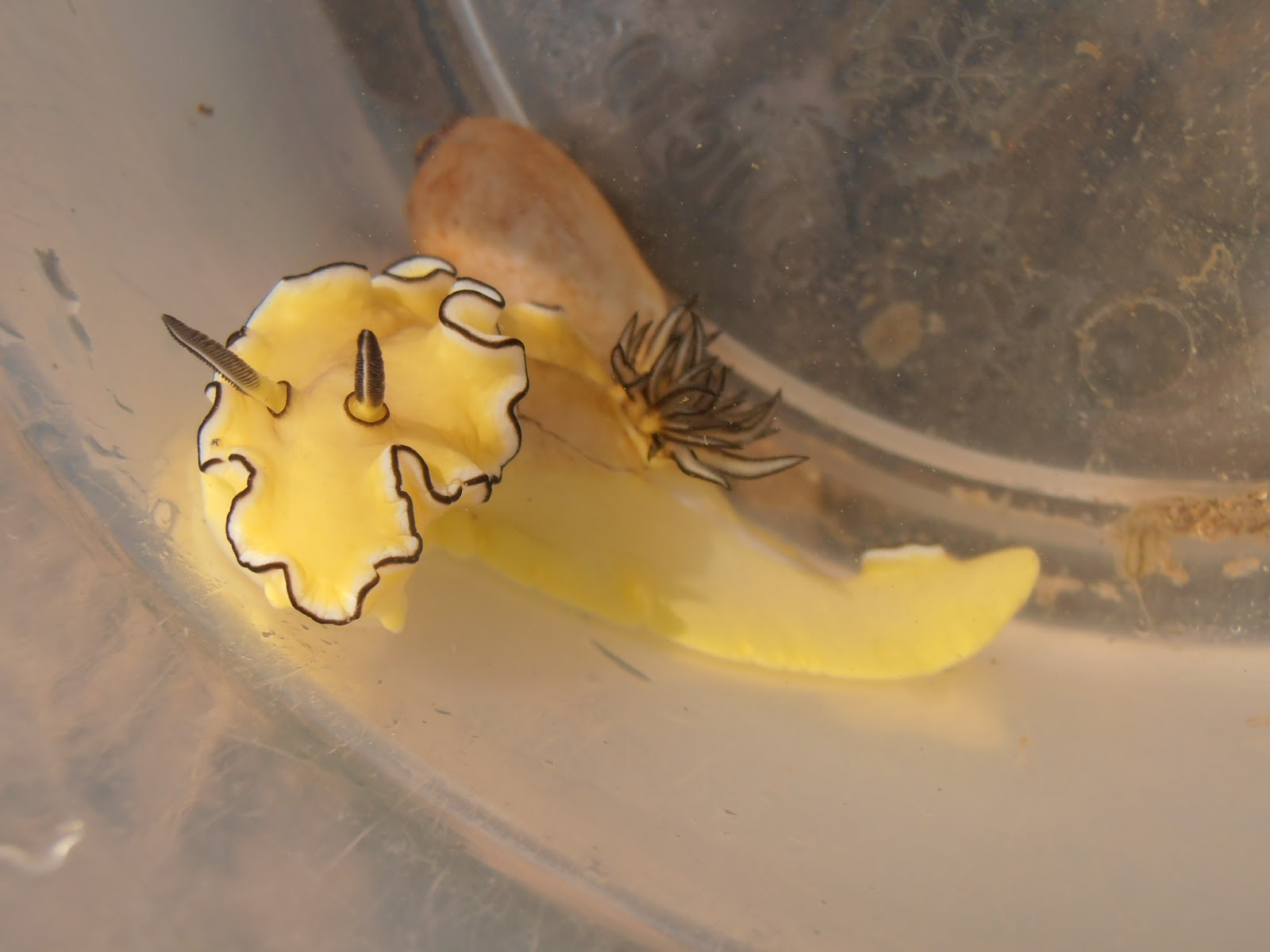
Delicate and graceful dancers of the sea... a Blue Dragon and a Black-margined Glossodoris nudibranch and a sea hare...


And our harmless armoured friends... Horseshoe Crabs that always delight participants...


And a baby squid adding a change of colours that wows everyone without fail...


Last but not least, a piece of heaven on earth in the gentle light of dawn.


How wonderful wonderful our world is, don't you agree?


And as for me, a sea squirt that I have not seen before...


Thank you, Chek Jawa : )